Every branded merchandise program hits the same inflection point. In the early days, someone on the marketing or people-ops team orders hoodies for an off-site, stacks the boxes under a desk, and hands them out one by one. It works — until it doesn't. The moment a company is shipping welcome kits to thirty new hires a month, restocking event booths across three cities, and fulfilling client gift requests from the sales team, the desk-and-spreadsheet approach collapses under its own weight. Orders ship late. Inventory counts drift. Someone discovers a pallet of medium t-shirts that expired from a campaign two quarters ago.
This guide covers the operational infrastructure behind merchandise programs that actually scale: warehousing, inventory management, pick-pack-ship workflows, multi-destination fulfillment, kitting, and cost optimization. Whether you are building internal capabilities or evaluating a fulfillment partner, these fundamentals apply. For the broader strategic framework behind every branded product decision, the complete guide to custom branded merchandise provides the foundation this guide builds on.
When you've outgrown ordering as needed
The ad-hoc ordering model — buying merchandise when someone requests it and shipping directly from the vendor — works at low volume. It requires no warehousing, no inventory tracking, and no fulfillment labor. But it trades operational simplicity for three escalating costs: lead time, per-unit price, and consistency.
Every time you order small quantities on demand, you pay rush production premiums, forfeit bulk pricing, and accept whatever vendor timeline you are given. You also lose control over quality consistency across orders — different production runs may yield slightly different colors, fits, or print quality. The transition from ordering as needed to maintaining stored inventory is not about warehouse ambition. It is about recognizing that the cost of not having inventory — in delays, premiums, and inconsistency — has exceeded the cost of holding it. Most teams hit this threshold somewhere between fifty and one hundred shipments per quarter. For a detailed comparison of on-demand versus bulk economics, the print on demand vs. bulk ordering guide breaks down the numbers.
Understanding fulfillment models
Merchandise fulfillment operates on a spectrum from fully internal to fully outsourced, with hybrid models in between.
In-house fulfillment means your team stores, picks, packs, and ships every order from your own space. You control everything — and you absorb all the labor, real estate, and operational overhead. This model works for companies with dedicated operations staff and physical space, typically those already managing a warehouse for other product lines.
Third-party logistics (3PL) providers store your inventory in their facilities and handle fulfillment on your behalf. You send them bulk inventory; they pick, pack, and ship individual orders as they come in. 3PLs offer scale, carrier discounts, and geographic distribution — but you give up some control over the unboxing experience and turnaround time.
Platform-integrated fulfillment combines a merch platform with built-in warehousing and shipping. The platform manages the catalog, the storefront, the inventory, and the fulfillment in a single system. This eliminates the integration complexity of connecting a separate storefront to a separate 3PL and is the model most purpose-built merchandise platforms, including Brandmerch storefronts, are designed around.
Setting up merchandise warehousing
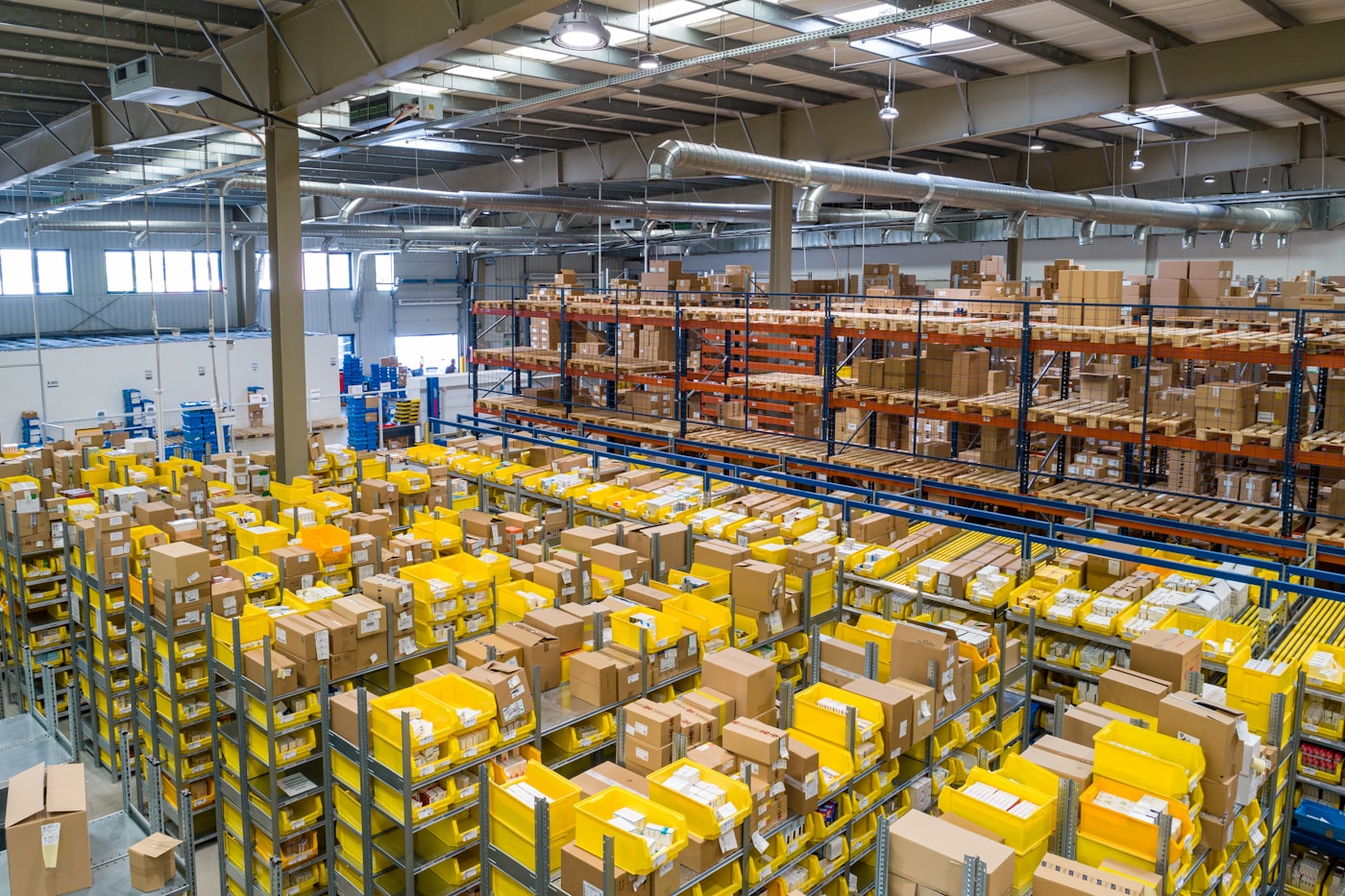
Whether you use a dedicated facility, a corner of your office, or a 3PL's shelves, the principles of merchandise warehousing are the same: organize by SKU, protect product quality, and enable fast retrieval.
Every product variant — each combination of item, size, color, and decoration — needs its own SKU and its own storage location. A hoodie in navy, size large, with the 2026 logo is a different SKU than the same hoodie in black, size medium, with last year's logo. Mixing them in the same bin creates picking errors that cascade through the fulfillment chain.
Environmental conditions matter more than most teams expect. Apparel needs dry, climate-controlled storage to prevent mildew and discoloration. Printed materials warp in humidity. Food items require temperature management and expiration tracking. Even basic merchandise benefits from shelving that keeps products off the floor, away from direct sunlight, and organized in a system that a new team member can navigate without tribal knowledge.
Inventory management fundamentals
Inventory management for merchandise is not the same as inventory management for e-commerce products. Merch inventory is campaign-driven, seasonal, and often tied to specific internal teams or events. The goal is not perpetual replenishment — it is having the right items available when a program needs them, without accumulating dead stock from programs that have ended.
Track three metrics for every SKU: quantity on hand, quantity committed (allocated to upcoming orders or programs), and quantity available (on hand minus committed). This prevents the classic failure where the inventory system shows fifty hoodies in stock but forty of them are already earmarked for next week's onboarding kits.
Set reorder points for your highest-volume SKUs based on lead time and consumption rate. If you burn through one hundred branded notebooks per month and your vendor needs three weeks to produce a new batch, your reorder trigger should fire when stock drops below one hundred units — giving you a full replenishment cycle of buffer. For items with unpredictable demand, maintain a safety stock of fifteen to twenty percent above your average monthly consumption.
Pick pack and ship operations
The pick-pack-ship workflow is where operational discipline either delivers or fails. Picking is retrieving the correct items from storage. Packing is assembling them into the correct configuration with appropriate packaging. Shipping is labeling, manifesting, and handing off to a carrier.
Accuracy at the picking stage prevents every downstream error. Use pick lists generated from order data — not memory, not verbal instructions. Each pick list should specify the SKU, quantity, storage location, and destination. For kitted orders with multiple items, a checklist approach where the picker confirms each component prevents partial shipments.
Packing standards should be documented and consistent. Define how items are folded, what tissue or filler material is used, where the packing slip goes, and how the box is sealed. These details sound trivial until a recipient opens a crumpled hoodie in a battered box — at which point the brand impression is already damaged. Shipping should integrate with your carrier accounts to auto-generate labels and tracking numbers. Manual label creation is a bottleneck that adds errors and eliminates the ability to provide real-time tracking to recipients.
Multi-destination fulfillment
Single-destination shipping — sending all orders to one address — is straightforward. Multi-destination fulfillment — shipping individual packages to dozens or hundreds of different addresses — is where complexity spikes. Welcome kit programs, client gifting campaigns, and remote team distributions all require multi-destination capabilities.
Address validation is the first checkpoint. Invalid or incomplete addresses cause failed deliveries, return shipping costs, and re-shipment delays. Validate every address at the point of collection using a postal verification API, not at the point of shipping when it is too late to correct. The employee welcome kit guide covers address collection workflows in detail, including timing relative to start dates.
Carrier selection for multi-destination shipments should factor in regional rates, delivery speed, and tracking reliability. A single carrier rarely offers the best rate and service level for every destination. Sophisticated fulfillment operations use multi-carrier rate-shopping to optimize cost and transit time per package.
Kitting and assembly
Kitting — assembling multiple individual products into a single packaged unit — is the operational backbone of welcome kits, event swag bags, and curated gift boxes. It transforms a collection of SKUs into a finished experience.
The key to efficient kitting is modular design. Define a core kit structure with fixed components and variable slots. A welcome kit might have a fixed core of hoodie, notebook, and water bottle, with a variable slot for a team-specific insert or a role-based accessory. This structure allows batch assembly of the fixed components while customizing only the variable elements per recipient.
Assembly instructions should be visual, not verbal. A laminated photo showing the exact arrangement of items in the box — what goes on top, how the tissue paper folds, where the card sits — produces consistent results regardless of who is assembling. For high-volume kitting, assembly-line workflows where each station handles one component are dramatically faster than having one person assemble each kit end to end.
Cost management and optimization
Fulfillment costs have four components: storage, labor, packaging materials, and shipping. Each can be optimized independently.
Storage costs scale with volume and duration. Minimize them by aligning inventory purchases to actual program timelines rather than speculative demand. Conduct quarterly inventory audits to identify slow-moving SKUs and either redeploy them into upcoming programs or liquidate them before they become dead stock.
Labor costs scale with order complexity. Simplify kitting configurations to reduce assembly time. Standardize packaging to reduce decision-making at the packing station. Invest in training that builds speed without sacrificing accuracy.
Shipping costs are the largest variable and the most negotiable. Consolidate carrier accounts to reach volume discount thresholds. Use dimensional weight optimization — choosing the smallest box that fits the contents — to avoid paying for empty space. For non-urgent shipments, ground shipping saves thirty to fifty percent over expedited options. Transparent cost breakdowns are available on the Brandmerch pricing page for teams evaluating platform-integrated fulfillment economics.
Choosing a fulfillment partner
If you are evaluating external fulfillment partners, assess them across five dimensions: integration capability (can they connect to your ordering system or storefront?), geographic coverage (do they have facilities close to your recipients?), customization flexibility (can they handle kitting, personalized inserts, and variable configurations?), transparency (do they provide real-time inventory visibility and shipment tracking?), and scalability (can they absorb volume spikes for events or seasonal programs without lead-time degradation?).
Request references from clients with similar volume profiles and program types. A 3PL that excels at high-volume single-SKU e-commerce fulfillment may struggle with low-volume, high-complexity kitted merchandise orders. The operational DNA is different, and the wrong fit creates friction that compounds with every shipment. For teams managing event merchandise alongside ongoing programs, the event and conference swag guide explores fulfillment considerations specific to time-sensitive, high-volume event logistics.
Scaling your fulfillment operations
Scaling fulfillment is not a linear exercise. The systems that work at one hundred shipments per month will not survive one thousand. Each growth phase requires deliberate infrastructure upgrades.
At low volume, spreadsheets and manual processes are acceptable. At mid volume — two hundred to five hundred shipments per month — you need a warehouse management system, barcode scanning for pick accuracy, and automated shipping label generation. At high volume — above one thousand shipments — you need multi-location inventory distribution, automated reorder triggers, real-time dashboards, and exception-handling workflows for address failures, stockouts, and returns.
The most important scaling decision is whether to build or buy. Building internal fulfillment capabilities gives you maximum control but requires ongoing investment in space, systems, and people. Buying — through a 3PL or an integrated merch platform — trades some control for operational leverage and the ability to scale without proportional headcount growth. Most merchandise programs land on a hybrid: owning the brand and product strategy internally while outsourcing the physical fulfillment to a partner whose core competency is logistics.
For teams ready to explore platform-integrated fulfillment that combines storefront management, inventory tracking, and shipping in a single system, the Brandmerch marketplace and storefront solutions are built specifically for this operational model. And for teams still mapping out their fulfillment strategy, the learning hub offers guides and frameworks for every stage of operational maturity. When you are ready to discuss your specific program requirements, reach out to the Brandmerch team to design a fulfillment architecture that fits your volume, complexity, and growth trajectory.